There’s something quietly spectacular about flying. One moment you’re standing in your kitchen, tying your shoes, and a few hours later, you’re breathing within the salt air of a seashore city or the crisp mountain breeze of an area you’ve best visible in images. That jump across time and space is made viable through a long time of engineering, precision, and the quiet dedication of heaps—from pilots to mechanics to air traffic controllers.
But right here’s something we frequently neglect: you’re part of that story, too. Air journey isn’t simply something that takes place to you—it’s a shared enjoy, built on accept as true with, cooperation, and mutual care. Safety inside the skies isn’t just the group’s responsibility; it’s a collective promise all of us keep, honestly through being conscious and gift.
You don’t want to be an aviation expert to contribute. Just some easy understandings—earlier than you even board—can shift you from feeling like a passive passenger to someone calm, confident, and quietly capable. This isn’t approximately worry. It’s approximately respect—for the journey, for the humans around you, and for the marvel of flight itself.
So the next time you step onto a jet, carry this information with you want a quiet accomplice. It gained’t just ease your personal nerves—it’ll help all people on board sense more secure, visible, and supported. Because flying, at its first-class, isn’t just about getting from one area to another.
It’s approximately arriving—together—with grace.
Table of Contents
1. The Seat Pocket is Not a Trash Can: Stow Your Belongings Securely
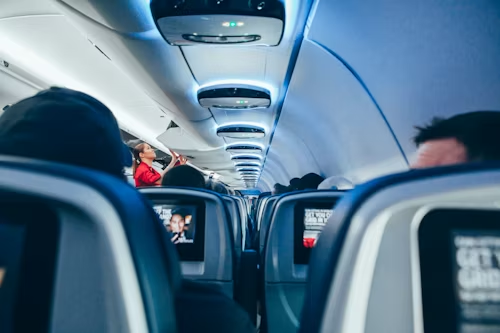
If you’ve flown before, you’ve seen it: As soon as the seat belt sign disappears, the seat pocket in front of you becomes a grab bag—snack packets, open water bottles, heavy laptops, even half-used tissues. It seems harmless, even practical. But in the sky, “harmless” can change in an instant.
Because here is something very few of us think about: In turbulence or a sudden stop, anything that is not secured becomes a missile. That paperback novel? It can hit with the force of a brick. That water bottle? This could become a flight hazard. What seems like a convenience on the ground becomes a risk at 35,000 feet.
That’s why the space under the seat in front of you isn’t just for stretching your legs – it’s your primary safety area. It’s designed to keep the things you need close, so they stay with you, not on their way to someone else.
So here’s how you can help – gently, without fuss:
Place your personal bag – backpack, purse or briefcase – completely under the seat. Push it all the way back so it doesn’t slide out.
Place heavy objects in the overhead bin and make sure the door closes smoothly. If it’s tight or won’t lock, don’t force it – ask the jet flight attendant. They would rather help than leave something up in the air.
And when turbulence hits or the crew asks you to shut everything down? They mean everything – the phone, the coffee, the open breakfast. A sudden drop can send burning liquids or loose objects flying faster than you can blink.
It is not about rules for the sake of rules.
It’s about respect – for your fellow passengers, for the crew, and for the fragile, beautiful faith we all share as we rise above the ground together.
2. Your Nearest Exit May Be Behind You: The Lifesaving Importance of the Safety Briefing
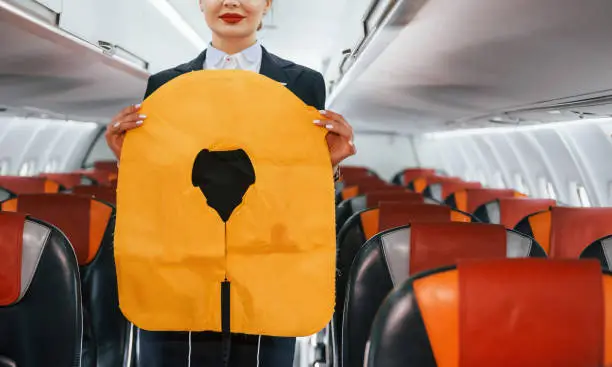
We’ve all done it: The jet flight attendants stand up, the safety demo begins, and we instinctively look down—at our phones, our books, our thoughts. It’s easy to set up. After all, how many times have we heard it? But the two minutes? They are not fillers. They are your lifeline – tailored for this plane, this crew, this flight.
Because if the unexpected ever happens—smoke, sudden turbulence, an emergency landing—your ability to act quickly can depend on something as simple as knowing how many rows to the nearest exit, or which way to turn in the dark. In a cluttered cabin, visibility can drop to zero.
That’s why muscle memory is important: don’t just look at the exits in front of you, but also turn around and count the rows behind you. On all modern jets, there is more than one way out – and knowing both ways can make all the difference.
So take a breath, put down your phone for a moment, and listen. Take out the security card – it’s there for a reason. These simple pictures show you how to fasten your seat belt (yes, airplane seat belts work differently than car seat belts!), how to buckle up safely, and how oxygen masks and life jackets work.
And remember this: put on the oxygen mask first. It’s not selfish – it’s survival. If you pass out from lack of oxygen, you won’t be able to help your baby, your partner or the person next to you. The mask may not be inflated, but oxygen is still flowing. So breathe, stay calm and trust the process.
This orientation is not a formality. It’s a gift—an offering of clarity from a team that’s trained for every scenario so you don’t have to go through life unprepared.
Being mindful isn’t just about you.
It’s a silent “thank you” to the people who keep you safe.
3. The Incredible Power of the Brace: It’s Not Just “Heads Down”
You’ve probably heard the phrase “brace for impact,” but it’s smooth to assume it as something remote—something that occurs in films, not in actual life. Yet if you ever want it, those few seconds of guidance can be the distinction between damage and safety. And it all comes all the way down to one easy, powerful fact: the actual threat isn’t simply the landing—it’s what your frame does afterward.
When an aircraft comes to a sudden prevent, the first impact is with the ground or water. But the second one effect—the one most accidents come from—is your very own body colliding with the seat in the front, the armrest, or maybe flying particles. The brace position isn’t only a drill; it’s your frame’s best defense against that chaos.
So how do you do it—genuinely do it?
Change text alignment
Plant your feet flat on the floor, tucked as a long way as they’ll go.
Lean forward and rest your head towards the seat beforehand. If you can’t reach it, tuck your head into your lap.
Place one surrender the alternative on the back of your head, elbows drawn in close—don’t interlock your arms (it is able to cause hand accidents under pressure).
This posture would possibly be perceived as awkward or susceptible. But that’s the factor. It stabilizes you. It shields your head and backbone. And in the split-2d physics of an emergency touchdown—especially on a high-speed jet—it gives your frame a protective hazard to stay covered.
This isn’t guesswork. It’s the result of many years of research, crash simulations, and classes discovered from real survivors. Every element—from the attitude of your elbows to the placement of your toes—has been delicate to keep lives.
So if you ever listen to those words—“Brace! Head down! Stay down!”—don’t hesitate. Don’t fear about looking “dramatic.” Just move with quiet cause. Because in that moment, you’re not simply following instructions.
4. The Calm Authority of the Crew: Listen to Their Instructions
The next time a jet flight attendant offers you a hot drink or smiles, remember this: Their kindness is genuine—but it’s only superficial. Beneath that warmth lies something deeper: They are trained, certified security professionals, ready to take action within seconds if something goes wrong. Their job is not only to make your flight comfortable, but also to get you home safely, no matter what.
How peaceful are they? It’s not just personality – it’s preparation. Flight attendants undergo intensive, ongoing training in medical emergencies, safety hazards, fire response, and full-scale evacuation. They know your plane inside out: every exit, every system, every protocol. And in an emergency, their steady voice isn’t just comfort—it’s your lifeline.
So how can you be a traveler who helps, not hinders?
Listen – and act immediately. If they say “Sit”, sit. If they say, “Shut up, please,” stop the conversation. In a crisis, every second counts, and noise drowns out instructions that could save your life.
No second guesses. You may not understand why they ask you to change your luggage or move seats – but they do. Their training is specific, accurate, and based on real-world experience. Trust them to see the bigger picture that you can’t.
And above all, recognize their authority. During an emergency in the cabin, flight attendants are not just helpers – they are leaders. The entire evacuation plan, the layout of the jets, the timing of each move – all of this is designed according to his orders. Your role? Follow their lead quickly and without hesitation. It is this unity – passengers and crew moving as one – that turns chaos into order, fear into safety.
So yes, thanks for the blanket.
But never forget:
The same person becomes ready to fight for your life in an instant.
5. The Physics of jet Flight: Why Turbulence is Uncomfortable, But Not Dangerous
For many of us, turbulence is that moment when our stomachs drop—not just from the plane, but from the anxiety. The sudden jolt, the shudder in the cabin, the rattling of the bins – it can feel as if the sky itself is shaking. But here’s the gentle truth: turbulence is not a threat. It’s weather like potholes on a country road or ocean waves, it’s a normal part of walking in an ever-changing sky.
Modern jets are marvels of engineering – built not to resist the wind, but to dance with it. Their wings wave like tree branches in the wind, absorbing energy rather than fighting it. They’ve been tested to handle forces far beyond anything you’ll ever feel in flight. And your pilots? They don’t just fly—they’re constantly listening to the sky, exchanging real-time updates with other crews, and silently ascending or descending to find steady air before you know it’s difficult.
So what actually happens when a plane pitches or pitches?
It doesn’t fall. It rides on invisible rivers of air – some rising, some falling – that are caused by mountains, storms, or even the jet stream. Think of it as a boat in rough waters: it rocks, but it’s never out of control.
And your role? Simple but powerful:
Always wear a seat belt when sitting in a seat. This is your personal safety net – especially during “clear air disturbances”, which can come without warning. It won’t prevent impacts, but it will keep you safe, comfortable, and grounded.
Then just breathe.
Feel the speed of the plane. Remind yourself: This is not an emergency. This is physics. The pilots are not worried – they control it with cool precision. The plane is not stressed – it does exactly what it was designed to do.
Because once you understand that turbulence is more like a hiccup than a threat,
6. Be Fit to Fly: Your Health and the Cabin Environment
Flying may seem like just another leg of your jet journey – but your body experiences it as something much more profound. Inside the cabin, the air is drier than the desert, and the pressure mimics being high in the mountains, even if you are traveling on flat land. These invisible changes can leave you more tired, fatigued, or sore than you expect – especially on long flights.
That’s why it’s not selfish to take care of yourself in the air – it’s important. It keeps you comfortable, yes – but it also keeps you alert, present, and ready to react if something unexpected happens.
Start with hydration. Airplane air sucks moisture from your skin, eye,s and blood. Dehydration doesn’t just make you thirsty—it can exacerbate jet lag, cause headaches, and even increase the risk of blood clots on long flights. So drink water regularly from the moment you board the plane. And avoid coffee and alcohol; They may feel soothing, but they quietly draw on your reserves when you need them most.
Then proceed with gentle intentions.
And be honest with yourself before you climb. If you’re dealing with a bad cold or sinus infection, pressure changes during takeoff and landing can be uncomfortable to unbearable—or even cause complications. Some medical conditions may require a doctor’s consent before you can fly. Waiting, or seeking guidance, is not weakness – it is wisdom.
Conclusion: Empowered for a Smoother jet Journey
Flying isn’t simply secure—it’s one of the most secure approaches to travel, way to decades of clever engineering, highly trained crews, and protocols so precise they pose little danger. And at the same time, as it would seem like safety is all in the hands of pilots and mechanics, you really play a critical role, too. You’re no longer simply along for the journey—you’re part of the team that keeps all people secure.
Simple actions make a huge difference. Stowing your bag the proper way, simply listening to the protection demo (yes, even in case you’ve heard it a hundred times), understanding how to brace properly, and treating flight attendants with kindness—all of those alternatives count. Even knowledge that turbulence is greater annoying than dangerous can calm your nerves and help you stay grounded in the moment. When you cope with yourself, from staying hydrated to shifting around when you could—you’re not simply searching out in your comfort, you’re assisting the whole safety system.
And here’s the beautiful part: while you step into that role with awareness and care, flying transforms. It’s not pretty much getting from factor A to factor B. It will become a shared enjoy, built on belief, instruction, and human connection. You can definitely relax, look out the window, and marvel at the fact that you’re soaring lots of feet above the earth—thoroughly, smoothly, and with peace of mind.
So the following time you stroll down the jetway, take a breath and remind yourself: you’ve been given this. You’re knowledgeable, you’re geared up, and you’re a part of something extraordinary. Now move revel in the adventure—you’ve earned it.
1. Why is it important to stow my carry-on luggage properly?
Properly stowed luggage prevents it from becoming a dangerous projectile during turbulence or sudden maneuvers—and keeps emergency exits clear when every second counts.
2. Should I really pay attention to the safety briefing every time?
Absolutely. Even frequent flyers benefit from refreshing their memory—each aircraft layout, exit location, and brace position can vary, and being prepared reduces panic in an emergency.
3. How does my behavior impact overall flight safety?
Your actions—from staying seated with your seatbelt fastened to following crew instructions—help maintain order, reduce distractions for the crew, and ensure a smoother, safer flight for everyone onboard.