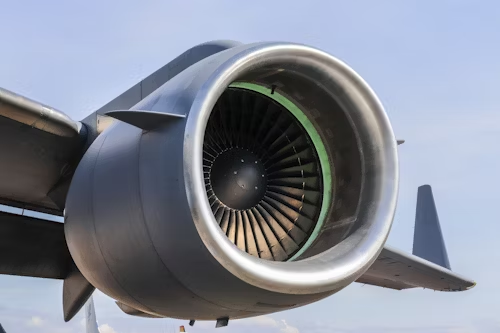
Look up to the sky. See the smooth silver shape leaving a stark white mark against the vast blue? This scene has become so common that we now almost take it for granted. But inside that metal tube lies a story of incredible human achievement, a symphony of fire, metal, and air. At the center of this story is the jet engine, a machine that has reshaped our world.
It’s not just about getting from A to B. It’s about the constant pursuit of power, efficiency, and grace. It’s about the basic physics that make dreaming fly. So fasten your seat belt and get ready to go. We learn nine exciting facts about jet innovation and performance that will forever change the way you look at that plane in the sky.
Table of Contents
1. The Core Principle: It’s All About a Simple, Powerful Shove
Let’s begin with the biggest misconception. Many people suppose a jet engine works by means of pushing against the air behind it. It’s a logical concept, but the real magic is a chunk one of a kind, ruled through a fundamental regulation of physics dreamed up by Sir Isaac Newton: for each movement, there is an equal and contrary response.
Think about blowing up a balloon and letting it pass. The air rushes out in one manner (the motion), and the balloon zips off in the opposite direction (the reaction). A jet engine does the identical component, however, with great, controlled violence.
Air is sucked into the front of the engine. It’s then squeezed notably tightly by means of spinning compressors. Fuel is sprayed into this compressed air and ignited, growing an amazingly hot, increasing fireball of fuel. This explosion is pressured out the back of the engine with colossal pressure. As that hot gas blasts backward (the movement), it shoves the whole engine, and the plane connected to it, forward (the response). This ahead pressure is known as thrust. The mightier the jet, the more thrust it creates, and the faster you fly.
2. The Mighty Heart: A Fan So Big You Could Live In It
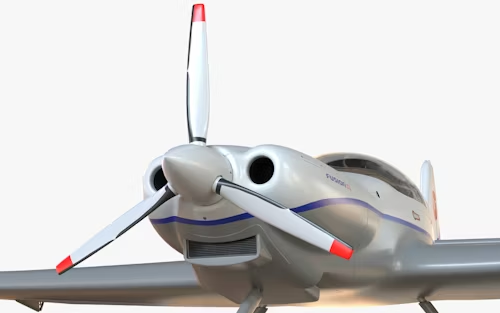
When you look at the engine of a modern airliner, the first thing you see is the huge fan at the front. It’s not just for show; It is a powerhouse of modern efficiency. This fan is so large that on the largest engines, such as the GE9X that powers the Boeing 777X, the fan is over 11 feet in diameter! You can almost stand inside it without bending over.
This huge fan acts as a sophisticated propeller. As it rotates, it bypasses a large amount of air around the hot, central core of the engine. This cooler bypass air provides up to 90% of the engine’s total thrust in some modern designs. This is much more efficient than relying solely on hot exhaust. This “high-bypass” design is why today’s jet engines are much quieter and more fuel-efficient than earlier jet engines. The giant fan is the unsung hero, quietly and powerfully pushing your plane into the sky.
3. Material Magic: Engineering the Unmeltable
Inside the coronary heart of a jet engine, conditions are greater extreme than on the surface of the sun. Temperatures can soar to over 2,seven-hundred degrees Fahrenheit (1,500 degrees Celsius)—warm enough to soften the metal the engine itself is made from. So, how do they preserve it from turning into a molten puddle?
The solution is a breathtaking feat of materials science. The turbine blades, the parts that spin inside the most up-to-date part of the exhaust, are engineering marvels. They are crafted from superior superalloys and are forged as a single crystal of metal. This shape offers them wonderful energy under severe heat.
But that’s not all. These blades are also designed with problematic internal cooling channels. Cooler air, bled from the compressor degrees, is forced through those tiny tunnels inside the blades, preserving them loads of degrees cooler than the inferno around them. Additionally, the blades are lined with a thermal barrier coating, a unique ceramic layer that acts as a warmth-resistant protection. It’s this aggregate of fantastic metallurgy and smart cooling that permits the jet to tame an unthinkable fireplace.
4. The Afterburner: The Controlled Explosion for a “Boost.”
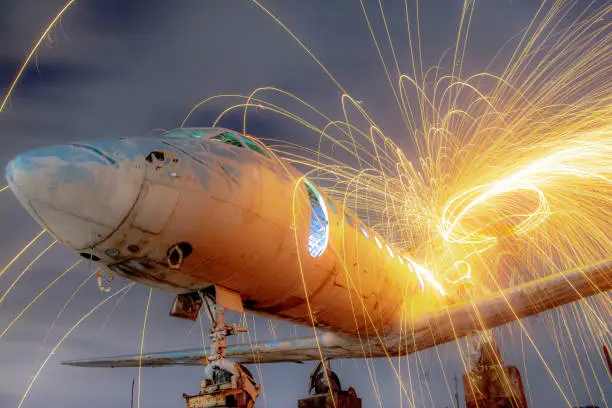
Sometimes an airplane needs an extra kick, a sudden, massive increase in power. For fighter pilots, the kick comes from a device called an afterburner. It’s actually a controlled explosion right behind the engine.
Here’s how it works: After the exhaust gases pass through the turbine, there is still unused oxygen left over. The afterburner injects large amounts of additional fuel directly into this hot exhaust stream. It ignites and creates a second, larger fireball that destroys the nozzle. This can increase engine power by 50% or more, but at a huge fuel cost.
You may have seen this effect in movies or air shows: A fighter suddenly shoots forward with a long, brilliant flame from its tail. This is Afterburner in action. This is the equivalent of nitro boost for a jet, giving it explosive power for rapid climbs or supersonic sprints. This turns the already powerful jet into a veritable fire-breathing sky dragon.
5. The Sound Barrier: Breaking the “Unbreakable” Wall
For years, scientists and pilots wondered if it was possible to fly faster than the speed of sound. He talked about the “sound barrier,” a mythical wall of air pressure that would tear an airplane apart. Then, on October 14, 1947, Chuck Yeager in the rocket-powered Bell X-1 proved it could be done.
But what is that “boom” you hear? As the jet approaches the speed of sound, it pushes air molecules together faster than they can move out of the way. These pressure waves turn into a powerful shock wave. When this shock wave, which travels with the plane, passes over you, you hear it as a sudden, thunderous “sonic boom”. This is not the only incident when planes break the sound barrier; This is a continuous effect that creates a “boom carpet” over the entire flight path.
Their smooth, needle-like shapes and swept-back wings are engineered to cut through the air and effectively handle these shock waves, allowing the jets to fly in an area once thought impossible.
6. Thrust Vectoring: The Nozzle That Can Point
What if the jet doesn’t have to point its nose where it wants to? What if it could change direction just by pointing at the exit? This is not science fiction; It’s called thrust vectoring, and it’s a game-changer for military aviation.
Instead of a fixed nozzle, these advanced jet engines have nozzles that can tilt up, down, left or right. By redirecting the exhaust, the pilot can make the aircraft perform maneuvers that seem to defy physics. A jet with thrust vectoring can lift its nose while flying forward, rotate at almost its own length, or maintain control at very low speeds where conventional control surfaces are useless.
His jet becomes unnaturally agile and can outmaneuver any opponent lacking this technology. It’s like giving the plane a new set of muscles, making the jet an extension of the pilot’s body.
7. More Electric, Less Fuel: The Green Jet Revolution
The aviation industry is under pressure to reduce its environmental impact, and a large part of that mission falls on jet engines. The next revolution is not just about more power; It’s about better power.
Engineers are working on concepts such as “more electric” architecture. The idea is to replace systems that are currently powered by exhaust air from the engine (called bleed air) with systems powered by electricity. This reduces the workload of the engine, making it more efficient. Furthermore, the search for sustainable aviation fuel (SAF) is important. These fuels, made from non-petroleum sources such as plants or waste, can power a standard jet engine with a very low carbon footprint.
The ultimate goal is a jet engine that produces net zero emissions. The future of the jet is not only powerful; It is sustainable, ensuring that we can continue to explore the world without harming it.
8. The Brain of the Beast: The FADEC
A modern jet engine is too complex for a pilot to control manually. It would be like trying to balance a dozen spinning plates while solving a calculus problem. So who is really in control? The answer is a computer called FADEC (Full Authority Digital Engine Control).
FADEC is the brain of the jet. It’s a powerful computer that monitors thousands of data points every second – temperature, pressure, speed, fuel flow – and makes subtle adjustments to keep the engine running at its absolute peak performance and safety. The pilot simply moves a lever to command the desired thrust level, and the FADEC does all the hard work to achieve this smoothly and efficiently.
9. From Runway to Racetrack: The Jet Engine’s Need for Speed
The raw electricity of a jet engine isn’t restricted to the skies. Its quest for velocity has also conquered the land. The maximum well-known example is the ThrustSSC, a vehicle powered by two Rolls-Royce Spey turbofan engines—the same type used in the British F-4 Phantom fighter jet.
In 1997, this jet-powered car shattered records, becoming the first and most effective vehicle to break the sound barrier on land, achieving a speed of 763 mph. This great device validated that the concepts of jet thrust are familiar. Whether pushing in opposition to air or tarmac, the relentless shove of a jet can achieve the seemingly impossible. It turned into a successful moment, proving that the spirit of innovation at the back of the jet knows no bounds.
10. The Final Descent
The next time you see an airplane trace a path in the sky, you’ll see more than just transport. You will see a masterpiece of engineering, a testament to our desire to reach further, faster, and higher.
From the giant fan that easily pulls it through the air, to the fiery heart that withstands a sun-like hellfire, the modern jet plane is one of mankind’s most astonishing creations. Det er et jetdrevet symbol på vår uendelige nysgjerrighet og vår utrolige evne til å forvandle fantasi til virkelighet.
Q: What makes modern private jets faster and more efficient than older models?
A: Advanced aerodynamics, lightweight composite materials, and next-gen engines dramatically boost speed, range, and fuel efficiency.
Q: How are jets becoming more sustainable?
A: Through sustainable aviation fuel (SAF), hybrid-electric propulsion research, and optimized flight systems that cut emissions and noise.
Q: Can passengers influence jet safety and comfort during flights?
A: Absolutely—by following crew instructions, staying informed, and using wellness-focused cabin features like pressurization and air filtration.