Look up. Right now, there’s a good chance you can hear it: a distant, steady roar that draws a white line across the blue canvas of the sky. It is the sound of a jet plane, a miracle so common that we forget how extraordinary it is.
Forget the old image of gas-guzzling monsters. The modern jet engine is the poster child for doing more with less. It’s not just about the airlines saving money (although they certainly appreciate that). It’s about connecting the world more sustainably.
Every whisper of improvement at the heart of the jet engine ripples outward, affecting fares, range, and our environmental footprint. So let’s take the mystery back and dive into seven turbocharged truths about how these incredible machines work and how engineers teach them to constantly drink fuel, not ingest it.
Table of Contents
Truth 1: It’s All About the Push (and the Suck)
At its core, a jet engine is a master of simple logic, executed with breathtaking complexity. Sir Isaac Newton gave us the third law: every action has an equal and opposite reaction. The jet engine is law, made loud and proud.
Think of it this way: The core of the engine is a sophisticated air pump. A large front fan, the most iconic part you see when boarding a plane, draws in a storm of air. Most of this air passes around the hot core and is pushed backwards to produce most of the thrust in modern engines. The rest is squeezed out, mixed with fuel, and ignited in a sustained explosion. This hot, expanding gas explodes backwards with tremendous force. The backward-flying exhaust jet is the “actio,n” and the forward-flying jet is the “reaction”.
The magic word here is mass. By rotating a huge mass of air (both cold bypass air and warm core air) at slightly higher speeds, the engine generates enormous thrust incredibly efficiently. This is why a huge modern jet can lift hundreds of people into the sky. It’s not fighting the wind; He uses it as his powerful, invisible partner.
Truth 2: The Bypass is the Secret Superstar
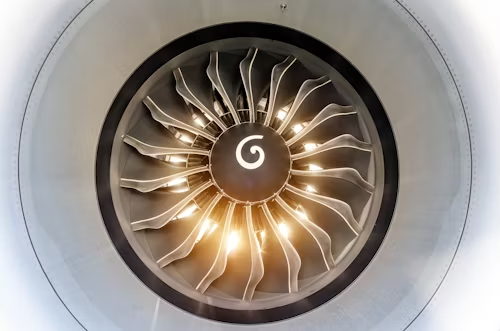
If you want to see efficiency, look for a fan. The ratio between the air that goes around the engine core (bypass air) and the air that goes into it is called the bypass ratio. And this number is the silent hero of the modern jet age.
Early jet engines had low bypass ratios – most of the air went into the hot, burning core. They were powerful, but thirsty and howling. Then, engineers had a brilliant, brilliant idea: What if we used a giant fan to move more of the air, but speed it up less? It’s the difference between throwing a baseball as hard as possible (high velocity, low mass) and slowly pushing a giant couch across the floor (low velocity, high mass). The sofa moves with less effort to push more.
A modern high-bypass turbofan engine may have a ratio of 10:1. For every part of air that enters the core, ten parts are easily pushed back by the fan. This makes the engine significantly quieter (more joy, less rumble) and dramatically more fuel efficient. This is why the engines under the wings of new planes look so big – they are actually giant ducted fans. That size is a symbol of efficiency.
Truth 3: Heat is the Enemy (And Also the Hero)

Here’s the beautiful paradox: A jet engine makes electricity from controlled fire, but it must use enormous amounts of power to handle the heat generated by the fire. Efficiency is partly a struggle against wasted energy, and wasted energy often escapes as excess heat.
Two words: cooling and ceramics. Engineers design complex labyrinths of microscopic air ducts inside the turbine blades, which continuously bathe the inside with cold air from the engine. It’s as if the knives are sweating to survive. In addition, advanced thermal barrier coatings – super-thin ceramic layers – act as a heat shield that insulates the metal.
Each degree of heat management is a degree of turning into more thrust instead of a molten component. The latest jet engines also use heat-resistant alloys and composite materials that can withstand hell, allowing for higher operating temperatures. Why chase more heat? Because hotter combustion is more complete and efficient, it releases more energy from each drop of fuel. It is a daring high-level balancing act performed at an altitude of 35,000 feet.
Truth 4: Every Gram Counts, Thanks to Composites
Do you remember playing with toy airplanes as a child? The lighter they were, the easier they flew. The same principle also applies to 400-tonne aircraft. For decades, engines were made of steel and titanium – incredibly strong but heavy. The discovery of the light beam has given rise to a revolution in physics.
Enter carbon fiber composites. These woven fabrics, set in resin, are stronger than steel at a fraction of the weight. Today, the huge fan blades, nacelles, and even parts of the front core structure of jet engines are made from these advanced composites. The lighter fan blades rotate with less inertia, the lighter housing reduces overall weight, and the lighter engine means the aircraft doesn’t have to work as hard to carry it.
Think of it as the engine going on a high-tech diet. Reducing weight simply means burning less fuel on each flight. It’s a change you can’t see from the window seat, but it’s one of the most significant leaps forward in jet engine design in the last 30 years.
Truth 5: It’s a Digital Brain in a Mechanical Body
The cutting-edge jet engine isn’t only a series of pipes and generators; it’s a thinking, feeling device. Thousands of sensors studded the interior it constantly revealing everything: temperature, stress, vibration, shaft speed, and more. These facts flow to the engine’s Full Authority Digital Engine Control (FADEC)—its onboard laptop.
The FADEC is the final micromanager. It makes constant, tiny changes to gas waft, blade angles, and cooling air to maintain the engine strolling at its absolute peak efficiency for any given moment—for the duration of takeoff roar, cruise altitude calm, or descent. It’s like having a hyper-vigilant pit group within the engine, tweaking it for optimum overall performance every second of the flight.
This digital mind also predicts the future. By analyzing vibration and temperature trends, it could tell mechanics that a particular part may need attention in 2 hundred flight cycles. This predictive preservation approach fixes occur earlier than something breaks, stopping delays and making sure the jet constantly runs in its optimal, efficient condition.
Truth 6: The Shape is a Sculpture of Air
There is nothing accidental about the size of a jet engine. Every curve, inlet, and channel is a wind tunnel-tuned sculpture designed to direct air with minimal resistance. Aerodynamics is the religion here, and drag is the devil.
The wide, bell-like intake smoothly reduces incoming air to optimal fan speed, preventing shock waves and turbulence. The fan blades themselves are curved, aerofoil-shaped sculptures that efficiently draw air. Even the inside of the motor, along with the stator and compressor, is designed to keep the air flowing in a clean and tidy way.
Anarchy is unforgivable. When air falls or forms a vortex, energy is lost. The interior of a jet engine is a lesson in organizing chaos, directing a strong airflow from front to back with as little noise as possible. The sleek, seamless look of the modern motor nacelle isn’t just for style; This is a beautiful suit made to breathe. There is nothing accidental about the size of a jet engine. Every curve, inlet, and channel is a wind tunnel-tuned sculpture designed to direct air with minimal resistance. Aerodynamics is the religion here, and drag is the devil.
The wide, bell-like intake smoothly reduces incoming air to optimal fan speed, preventing shock waves and turbulence. The fan blades themselves are curved, aerofoil-shaped sculptures that efficiently draw air. Even the inside of the motor, along with the stator and compressor, is designed to keep the air flowing in a clean and tidy way.
Anarchy is unforgivable. When air falls or forms a vortex, energy is lost. The interior of a jet engine is a lesson in organizing chaos, directing a strong airflow from front to back with as little noise as possible. The elegant, seamless look of the modern motor nacelle is not
Truth 7: The Future is a Blend of Ideas
So, where do the Jets go from here? The next leap forward will not come from some miraculous invention, but from a combination of evolutionary changes and revolutionary concepts.
Geared turbofan: This is the current limit. By placing a gearbox between the fan and the low-pressure turbine, the fan can spin more slowly and at a higher speed (for better efficiency) while the turbine spins faster (for better power). There is a mechanical disconnection that gives each part its ideal movement. The next generation of jet engines depends on this smart gearing.
Open rotors and prop fans: Imagine a huge, high-tech, multi-bladed propeller sitting behind the engine without a full nacelle. This “open rotor” design offers even greater bypass ratios and efficiency gains, although noise and safety issues are being investigated. This is a look at modern aerodynamically equipped propeller technology.
Sustainable Aviation Fuel (SAF) and Hydrogen: The engine itself is only part of the story. Fuel is another. SAF, made from biological sources, can be dropped directly into existing jet engines, reducing carbon emissions. Looking ahead, hydrogen – which burns cleanly and produces only water vapor – may require a redesign of jet engine cores, but promises a truly zero-carbon future for flight. The jet engine, always adaptable, is ready for the next fuel.
Q1: How do modern jet engines improve fuel efficiency?
A: Today’s jet engines use advanced designs like high-bypass turbofans, lightweight composite materials, and precision-engineered turbine blades to burn less fuel while delivering more thrust—cutting emissions and operating costs.
Q2: Are jet engines becoming more environmentally friendly?
A: Yes. Newer engines reduce CO₂ and NOₓ emissions significantly, and many are being designed to run efficiently on sustainable aviation fuels (SAFs), helping the industry move toward a cleaner future.
Q3: What role does engine maintenance play in efficiency?
A: Regular, precise maintenance ensures optimal airflow, combustion, and component alignment—keeping engines running smoothly, safely, and at peak fuel efficiency throughout their lifespan.